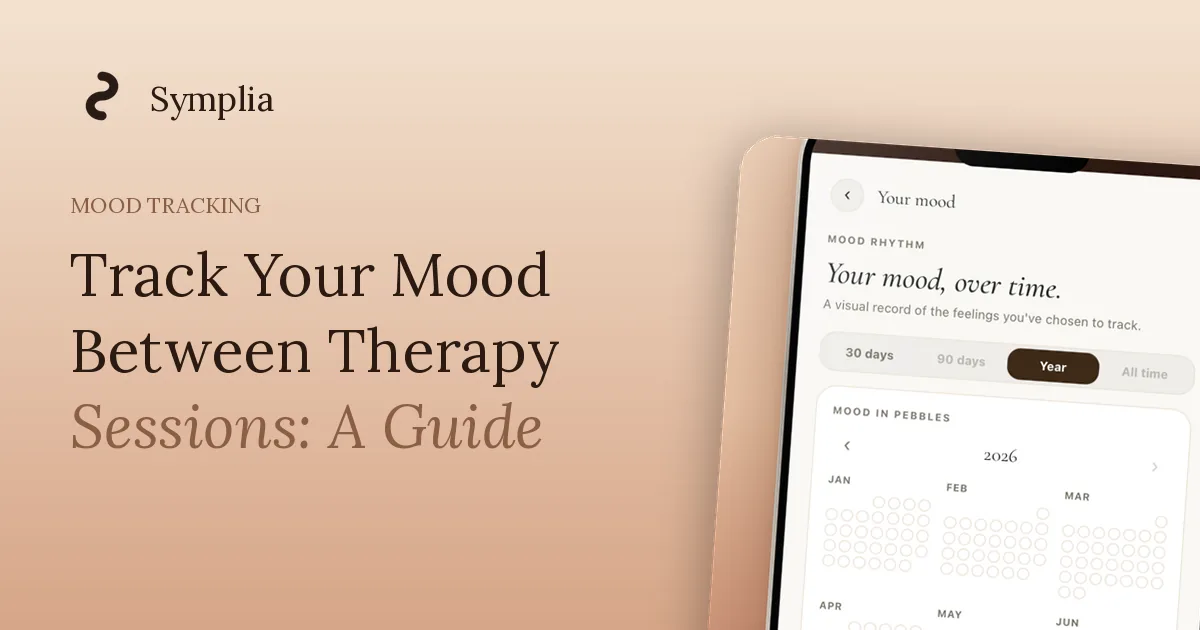
A lot of people in therapy start tracking their mood at some point, usually after their therapist suggests it. They download a mood app, log their mood for a few weeks, accumulate some colorful charts, and then are not quite sure what to do with any of it.
The problem is not the tracking. The problem is that the tracking is not connected to anything. It is producing data without producing insight.
What mood tracking is actually for
The goal of mood tracking in a therapy context is not to have a record of your emotional history. The goal is to help you and your therapist see patterns that are hard to see from inside the experience.
You cannot always tell from week to week whether things are improving. Bad weeks feel representative. Good weeks feel like exceptions. Only when you look at several weeks of data together can you see things like: anxiety tends to peak on Sunday evenings, mood is consistently higher after certain activities, the week after a therapy session tends to be better than the week before.
These patterns are the raw material for therapy.
The basic practice
Check in at the same time every day. Morning or evening works better than midday.
Log your mood on a simple scale. A 5-point scale is enough to show meaningful variation over time.
Add one note. Not a full journal entry, one sentence. "Slept badly." "Good meeting at work." "Argument with my partner." This context is what turns a number into information.
Do it consistently. Inconsistent mood tracking produces inconsistent data. Even if you miss days, return to it.
What to do with the data
Before each therapy session, spend five minutes reviewing your mood data from the past week or two. Look for patterns and outliers.
Bring what you notice to your session. "I looked at my mood tracking and I noticed it is consistently lower on the days I do not leave the house" is a better session opener than trying to recall impressions from the past two weeks.
Common mistakes
Tracking without reviewing. Data that is never reviewed is wasted effort. Schedule a brief review before each session.
Tracking too many things at once. Starting with mood and one or two additional factors is enough.
Abandoning it after a difficult week. Difficult weeks produce the most useful data.
Using the data to judge yourself. Mood tracking is observational, not evaluative.
Apps that make this useful
Symplia tracks mood daily within the context of your therapy. The mood data connects to your session prep so by the time your appointment comes around, your mood history is already organized. Every Symplia plan includes every feature. Monthly and Annual plans include a 7-day free trial. Try Symplia at app.symplia.app.
Bearable tracks mood alongside a wide range of health factors and produces correlation reports.
Daylio is the fastest and simplest option for daily mood logging. It does not connect to therapy sessions but it is easy to maintain consistently.
Symplia is a therapy companion app with built-in mood tracking and session prep. Monthly and Annual plans include a 7-day free trial. Try Symplia at app.symplia.app.