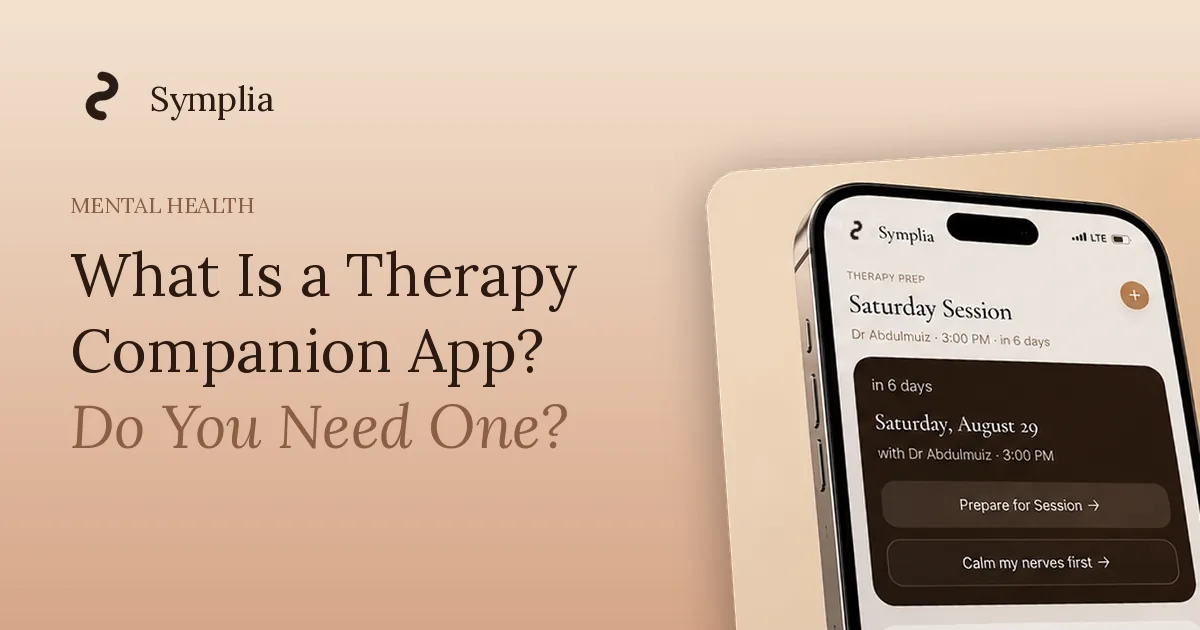
What Is a Therapy Companion App? And Do You Actually Need One?
When I started polling people on Threads about their experience in therapy, one thing came up again and again. Not that therapy was bad. Not that their therapist was wrong for them. It was that the time between sessions felt like dead air. They would have a good session, walk out feeling clearer, and then two weeks later show up to the next one and spend the first fifteen minutes just trying to get back to where they were.
That gap is what a therapy companion app is designed to fill.
The category gets confused with a lot of other things, so let me be specific about what it is and what it is not before we go further.
What a therapy companion app actually is
A therapy companion app is a tool for the time between therapy appointments. Not the appointments themselves. Not instead of a therapist. The 166 hours between a weekly session that most people spend without any structured support, without notes, without any record of what happened or how they felt.
The core idea is simple. Your therapist works with what you bring into the room. If you can bring more, more clearly, your therapy moves faster.
What that looks like in practice:
Journaling between sessions. A private space to write thoughts and feelings as they happen, not days later when memory has smoothed them out. The argument you had with your partner on Tuesday is a different thing to write about on Tuesday than it is to vaguely recall on Friday.
Mood tracking. A daily check-in that builds a picture of your emotional patterns over time. One week of mood data changes what your therapist can see and respond to. Saying "I notice my anxiety tends to spike on Sunday evenings" is more useful to work with than "I feel anxious sometimes."
Session prep. A structured way to build a short note before each appointment covering what you want to discuss, how you have been feeling, and anything important your therapist should know. People who arrive prepared move faster in therapy. This is consistent across the research.
Post-session reflection. A space to capture what you learned and what you want to hold onto before the memory fades. Session insights have a short shelf life without somewhere to put them.
Pattern recognition. Over time, a therapy companion builds a picture of your emotional life. What correlates with harder weeks. What helps. What keeps coming up. Some apps surface these automatically. Others give you the data and let you draw your own conclusions.
What a therapy companion app is not
This distinction matters a lot.
It is not therapy. A therapy companion app does not provide clinical support, crisis intervention, or any kind of treatment. If you are in acute distress, contact a mental health professional directly.
It is not a therapy replacement. Apps like BetterHelp and Talkspace connect you with licensed therapists over text, audio, and video. A therapy companion assumes you already have a therapist and helps you use that relationship more effectively.
It is not an AI chatbot therapist. Woebot, Wysa, and similar apps engage you in CBT-based conversation. They are trying to do something therapeutic through a chat interface. A therapy companion is not trying to conduct therapy. It is a support tool for reflection and preparation, not a clinical intervention.
It is not a general wellness app. Calm and Headspace are meditation and stress management tools. Useful, but not built around the therapy relationship. A therapy companion is specifically for people who have a therapist.
Who gets the most out of it
You will get real value from a therapy companion if you are currently in therapy and feel like you are not getting the most from it. If sessions often feel like you are starting from scratch, or you leave with a sense that you missed something important, a tool for preparation and reflection changes that.
You will also get value if a lot happens to you between sessions and it tends to blur together. Most people's weeks contain more than they are able to bring to a 50 minute conversation. Having a record means you can bring more.
For people with ADHD specifically, the between-session period is where a lot of therapy value gets lost. Emotional recall is harder. The thing that felt significant on Monday has lost its texture by Thursday. Voice journaling and low-friction quick-log tools help bridge that.
What to look for
Not all mental health apps in this space are built with the same clarity of purpose.
Low-friction capture. The most important thing. If journaling requires effort, you will not do it during the moments when it matters most. The best therapy companions make it possible to record something in thirty seconds.
Privacy and data ownership. Your mental health data is sensitive. Look for clear privacy policies, encryption, and no selling of your data. Read the actual terms before you sign up.
Something built around your sessions. The clearest difference between a therapy companion and a general journaling app is whether it is structured around your therapy appointments. Countdowns, prep prompts, post-session reflection. If the app has no concept of a therapy session, it is something else.
No chatbot therapy. A therapy companion that starts trying to conduct therapy through conversation is overreaching. The best tools stay in their lane.
Does it actually help?
Here is an honest answer.
A therapy companion will not make bad therapy good. If the relationship with your therapist is not working, preparation will not fix that.
What it will do is help you bring more of yourself into the room. Help your therapist help you, faster. And turn the time between sessions from dead air into something active rather than passive.
For most people in therapy, that is a meaningful shift. The work you do in those 50 minutes is only as good as what you bring in and what you do with what you leave with.
About Symplia
Symplia is a therapy companion app built specifically for this. Daily mood tracking with trend views, voice-to-text journaling, structured session prep, post-session reflection, and an ADHD Thought Dump tool for clearing your head before each appointment.
Not a chatbot. Not trying to be therapy. Built to support the therapy you are already doing.
Monthly and Annual plans include a 7-day free trial. Try Symplia at app.symplia.app. You can also try the free ADHD Thought Dump tool at symplia.app/tools/adhd-thought-dump.
Frequently asked questions
Is a therapy companion app the same as a mental health app?
Not exactly. Mental health app covers a huge range, from meditation tools to teletherapy platforms to crisis support. A therapy companion is specifically for people already in therapy, focused on the time between sessions.
Can I use one without a therapist?
Yes. The journaling and mood tracking are useful on their own. But the session prep functionality is most useful when you have actual sessions to prepare for.
Do therapists recommend these apps?
Some do, particularly therapists who encourage between-session journaling or mood tracking. It is worth mentioning to your therapist that you are using one. They may find your prep notes useful in session.
Is my data private?
It should be. Check the privacy policy before you sign up. Look specifically for whether data is sold to third parties and whether you can export or delete your information.
How is this different from Woebot or Wysa?
Woebot and Wysa use AI to conduct structured CBT-based conversations. They are closer to an automated therapy supplement. A therapy companion like Symplia does not try to conduct therapy. It supports your self-reflection and session preparation, working alongside your therapist rather than substituting for one.
Symplia is a between-session therapy companion app for journaling, mood tracking, and session preparation. Monthly and Annual plans include a 7-day free trial. Try Symplia at app.symplia.app.