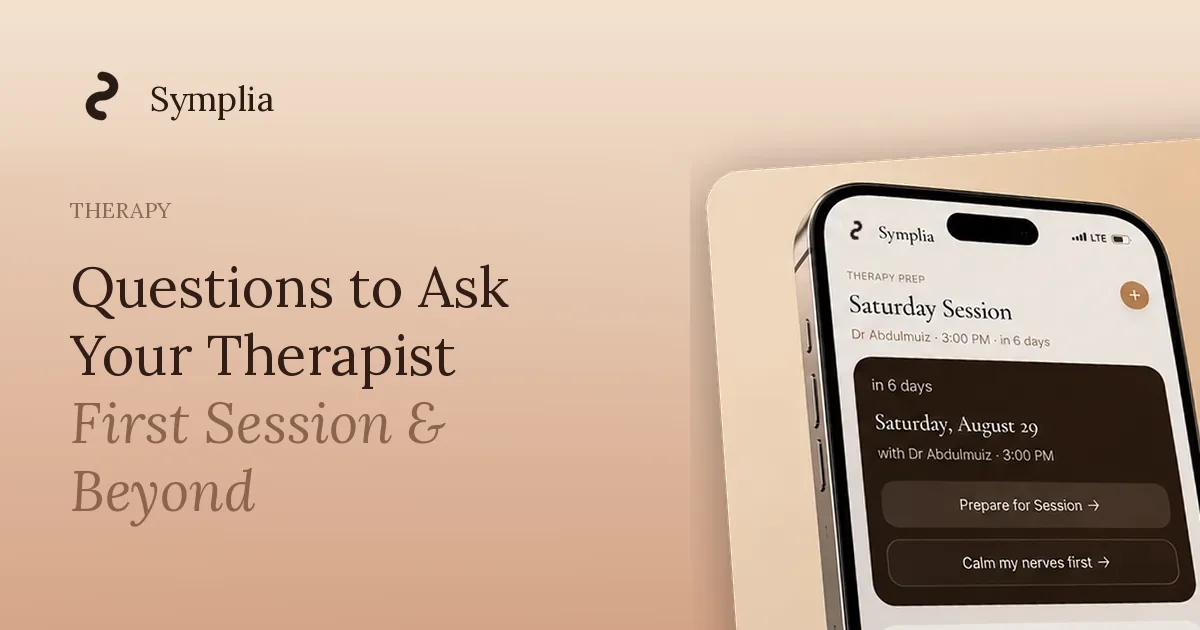
The best questions to ask your therapist are practical and honest: how they work, what they have experience with, what sessions will look like, how you will know whether it is helping, and what happens if it is not a good fit. You do not need all of them. Pick five or six that matter to you, write them down, and ask them across the first few sessions rather than all at once.
A good therapist expects questions, and asking them is part of choosing well. If you are unsure what day one involves, read what to expect in your first therapy session alongside this list.
Before you commit
Many therapists offer a short call or a first appointment where you can ask about fit before deciding to continue. These questions work well there.
Approach and experience
- How would you describe the way you usually work with clients?
- What does a typical session look like with you?
- Have you worked with people dealing with something like what I am facing?
- What would you expect us to focus on first?
- Do you tend to be more structured, with goals and exercises, or more open-ended?
- Is there anything about my situation that you think might be outside your experience, and would you tell me if so?
Fees, cancellation and logistics
- What is your fee per session, and do you offer any sliding scale or reduced rate?
- How does payment work, and do you give receipts I could use for insurance or reimbursement where that applies?
- What is your cancellation policy, and how much notice do you need?
- How often do you usually suggest meeting, and can that change over time?
- Do you offer online or phone sessions if I cannot attend in person?
- Can I contact you between sessions, and if so, how?
If cost is a worry, the therapy cost calculator can help you see what different session frequencies might add up to before you decide.
How progress is reviewed
- How will we decide together what I am working toward?
- How often will we step back and look at whether things are moving?
- If I feel stuck, is it okay to tell you, and what happens then?
In the first session
The first session is often part conversation, part information gathering. You are allowed to ask questions in it, even while the therapist is asking you plenty.
- What do you need to know about me to get started well?
- What should I expect from the next few sessions?
- Is there anything you would like me to do or think about between now and next time?
- How do you prefer I bring up things I find embarrassing or hard to say?
- Is it okay if I take notes during sessions, or bring a list of things to discuss?
After a few weeks
Once you have a feel for the rhythm, you can ask questions that are harder to answer on day one.
- What patterns are you noticing in what I bring?
- Is there something I keep avoiding that we might look at?
- What do you think is going well so far?
- Is there a part of this I could be doing differently to get more from it?
- Would it help if I tracked something between sessions, such as mood or sleep?
- How are you thinking about my goals now compared with when we started?
For ideas on what is worth bringing up, see what to talk about in therapy. If you want a way to tell whether things are shifting, how to know if therapy is working covers signs worth noticing.
When something is not working
It can feel awkward to say this out loud. It is also one of the most useful things you can bring to a therapist, because most would rather hear it than lose you silently.
- I am not sure this approach suits me. Could we try something different?
- I feel like we keep covering the same ground. How do we move forward?
- Sometimes I leave sessions feeling worse. Is that expected, and what can we do about it?
- I find it hard to be honest with you about some things. Can we talk about why?
- Would a different kind of therapist or approach suit me better, and would you help me find one?
- Can we pause and review what is and is not helping?
Confidentiality
Confidentiality practices and the laws around them vary by country, region and profession, so these questions are worth asking directly rather than assuming. Therapists generally explain their own policies in the first session or in a written agreement.
- What stays between us, and are there situations where you might need to share something?
- How do you store my notes and records, and for how long?
- If I use insurance or an employer benefit, what information might be shared with them?
- If I am under a certain age, or involve a family member, how does that change what is shared?
- Will you tell me if you ever need to break confidentiality?
When you are thinking about ending therapy
Therapy does not have to run forever, and you can raise the subject of ending at any point.
- How will we know when I am ready to finish?
- Can we reduce sessions gradually instead of stopping all at once?
- What should I keep doing after we end?
- Could I come back later if I needed to?
- Can we use a final session to look back at what has changed?
How to write your questions down and bring them
A list on your phone or a page in a notebook is enough. Write a question when it occurs to you during the week, because it will be gone by the time you sit down. A short note such as "ask about fees" or "why do I freeze when I am criticised" is enough to jog your memory.
Before each session, pick the one or two that matter most and put them near the top. You can open your session by saying, "I wrote a few questions down, is it okay if I start with one?" Therapists tend to welcome this because it shows what you care about.
If you want a simple structure, the therapy session prep page explains how a short routine before each appointment can help, and how to get more out of therapy has broader ideas.
How to ask a hard question
Some questions feel risky, such as "Is this helping?" or "Do you think I will get better?" A few things can make them easier:
- Say that it is hard to ask. "This feels awkward, but I want to ask..." gives your therapist context.
- Keep it specific. "I am not sure what we are working on" is easier to answer than "this is not working."
- Ask for their view, then say how it landed. You are allowed to say you are still unsure.
- If you freeze, write it down and hand it over or read it aloud.
You can ask about style and fit
It is reasonable to ask a therapist how they work and whether they think you are a good match. Fit matters, and many people find it makes a real difference to how comfortable they feel. Questions about style, such as how directive they are or how they handle silence, are not rude. They help you both decide whether this is the right partnership. If it is not, a good therapist can often help you think about what you do need.
When to get support
If you are in distress, or you feel unsafe, contact a licensed professional, your local emergency services, or a crisis line in your country. A list of questions is no substitute for urgent help.
Where Symplia fits
Symplia is a private mental health app that can help you collect your questions and thoughts between sessions. You can jot down what comes up in your journal, use Session Prep to organise what you want to raise, and choose what to share with your therapist. It is not therapy and does not replace it.
Try Symplia free at app.symplia.app. Monthly and Annual plans include a 7-day free trial.
Frequently asked questions
What are good questions to ask a therapist in the first session?
Start with how they work, what a typical session looks like, and what they would expect you to focus on first. Asking about fees, cancellation and confidentiality is also normal and helps you feel settled.
Is it okay to ask a therapist about their experience?
Yes. Asking whether they have worked with concerns like yours is a common and reasonable question. A good therapist will answer honestly, including saying when something is outside their experience.
Can I bring a list of questions to therapy?
Yes, and many therapists welcome it. A short list on your phone or in a notebook helps you stay on track and shows what matters to you.
How many questions should I ask at once?
You do not need to ask everything in one go. Choose a few that matter most and spread the rest across the first several sessions.
What if my therapist does not answer my question?
You can say you would like a clearer answer, or ask why they prefer not to answer. If you still feel unsatisfied, that may be useful information about whether it is a good fit.
Can I ask my therapist if therapy is working?
Yes. It is a fair question, and many therapists review progress with clients from time to time. Asking directly can open a useful conversation about goals and next steps.