Therapy works. The research is clear: having a trained professional help you see yourself more clearly, over time, with consistent practice, produces real change in how you think, feel, and behave.
But the research also shows something that does not get talked about enough: outcomes vary significantly based on how engaged clients are between sessions. Therapy is not something that happens to you for 50 minutes a week. It is a practice that those 50 minutes support.
If you have ever left a session feeling like you barely scratched the surface, these habits are for you.
Arrive prepared, not hoping for inspiration
The most consistent predictor of a productive therapy session is whether the client arrived with something specific. Not a perfectly formed agenda. Just something specific.
"I want to understand why the argument with my partner triggered such a disproportionate response" is specific. "Things have been hard" is not.
Preparation does not mean scripting the session. It means spending a few minutes before your appointment identifying what you most want to work on.
Track your week, not just your sessions
What happens between sessions is the raw material for your therapy. Most people are not capturing it. They have a difficult Tuesday and by Thursday the details have faded.
The fix is simple: log things as they happen. A voice memo, a note in your phone, a two-sentence journal entry. When something feels significant, capture it.
A week of notes is incomparably more useful than a week of memory when you sit down with your therapist.
Say the uncomfortable thing
Most therapy clients unconsciously edit. They present the version of themselves and their week that feels manageable, and leave out the parts that feel embarrassing or hard to explain.
The parts you leave out are almost always the parts most worth saying.
You do not have to be brave. You can say "there's something I don't want to bring up" and let your therapist help you approach it.
Use what you learn between sessions
After a session, you will often leave with some kind of insight or tool. Most people let it dissolve within a few days.
Write down three things from each session before you leave the therapy context. Not a summary, just the pieces you want to hold onto. Then use them. If your therapist suggested a technique, practice it at least once before your next session.
Tell your therapist when something is not working
If the sessions feel surface-level, say so. If the approach you are using does not seem to be helping, say so. Your therapist cannot adjust what they do not know is not working.
Symplia was built for this
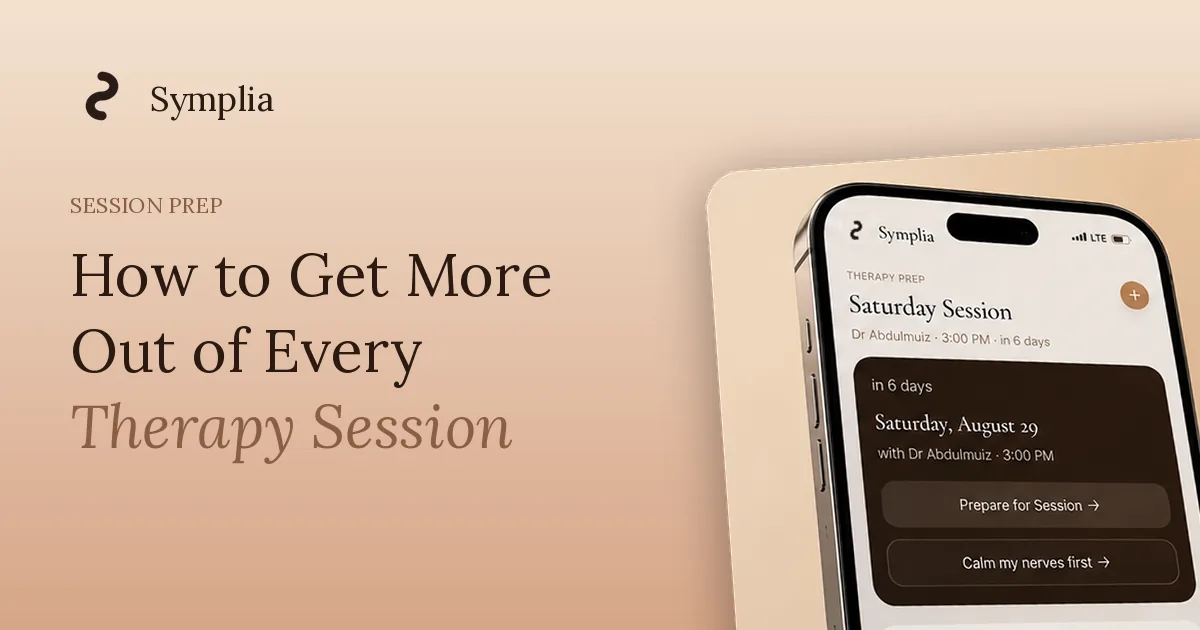
The habits in this post are what Symplia is designed to support. You log throughout the week, build a prep note before each appointment, and capture what you want to hold onto afterward.
Monthly and Annual plans include a 7-day free trial. Try Symplia at app.symplia.app.
Symplia is a between-session therapy companion app. Monthly and Annual plans include a 7-day free trial. Try Symplia at app.symplia.app.