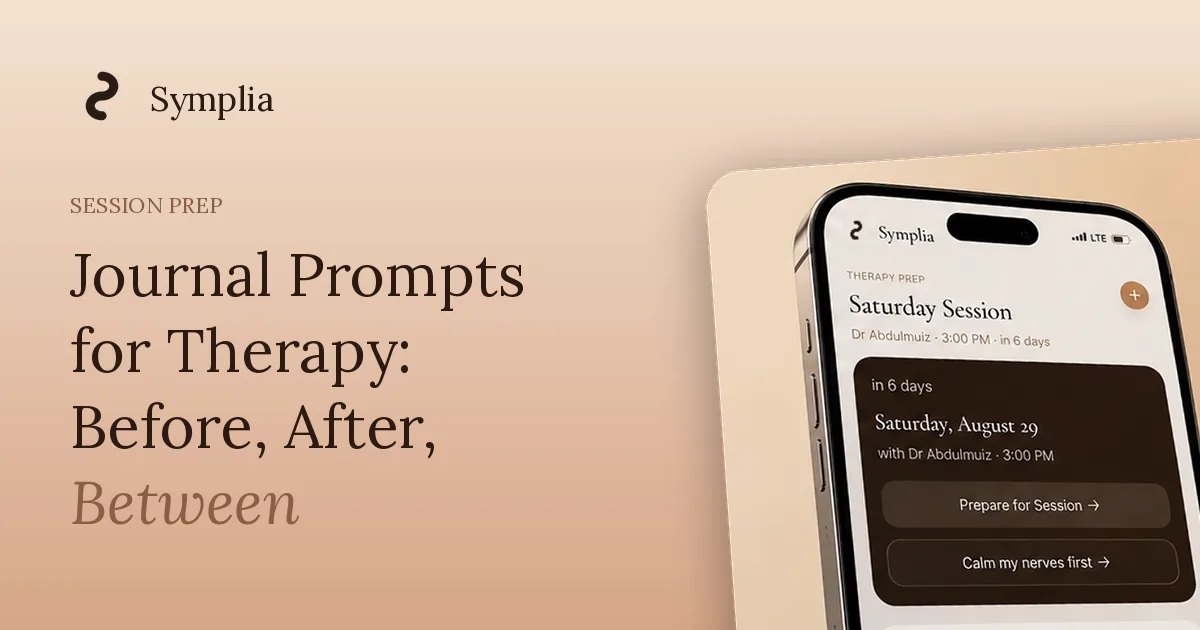
The most useful journal prompts for therapy fall into three moments: before a session, to decide what to bring; after a session, to capture what stood out; and between sessions, to notice what happens in daily life. Spend five minutes on one or two prompts from each group. You do not need long entries. A few honest lines can make your next session more focused and help therapy feel continuous instead of weekly.
Below are 24 prompts, grouped by when to use them. Pick what fits and ignore the rest.
Why journal around therapy
A session is usually about fifty minutes, and a week is a long time. By the time you sit down, the thing that bothered you on Tuesday can be hard to remember or put into words. Writing helps because:
- It captures details while they are fresh.
- It helps you decide what matters most before the clock starts.
- It lets you notice patterns across weeks, not just single events.
- It keeps insights from fading after you leave.
These journal prompts are meant to sit alongside therapy. They are not therapy, and your therapist can guide you better than any list. If you want a full approach to the preparation side, see what session prep is.
Before a session: decide what to bring
Try these a day or two before, or in the waiting room.
- What has been the hardest part of this week, and what made it hard?
- If I only had time to talk about one thing, what would it be?
- What have I been holding back from saying, and what feels risky about it?
- What changed since last time, for better or worse?
- What do I want my therapist to understand about how I have been feeling, in two sentences?
- What question have I been wanting to ask but have not?
- Is there anything I want to ask my therapist to explain or approach differently?
For more ideas on putting thoughts into words, see what to say to your therapist. If you like a ready-made structure, the therapy session prep page shows how a pre-session note can work.
After a session: capture what stood out
Write within a few hours if you can, while it is still fresh. Our guide to post-session therapy journaling goes deeper.
- What moment from the session am I still thinking about?
- What did I feel as I left, such as lighter, drained, confused or restless?
- What did my therapist say that I want to remember word for word?
- What did I learn about myself today that surprised me?
- What did I agree to try before next time, and what could get in the way?
- What did I not get to say, and when can I bring it up?
If the session was heavy, do something gentle first, and write later. You do not have to process everything at once.
Between sessions: notice real life
This is where change usually happens, in ordinary days and small moments.
- When did I notice an old pattern this week, and what did I do instead, if anything?
- What situation made me react strongly, and what was underneath the reaction?
- Did I try something from therapy this week? What happened?
- What was a small win this week that I would not have managed a few months ago?
- What did I put off this week, and what was I protecting myself from?
- What was a moment I felt at ease, and what was different about it?
If your therapist gives you exercises, therapy homework is a good place to keep them organised. You can also read how to track mood between therapy sessions so patterns are easier to describe.
Look at the bigger picture
Every few weeks, try one of these when you have a quiet ten minutes.
- What am I working on in therapy right now, in my own words?
- What feels different from when I started?
- What still feels stuck, and what do I think it needs?
- What do I want from the next month of therapy?
- What do I want to tell my therapist about how the process is working for me?
The last one matters. Feedback about the therapy itself is welcome in most settings, and it helps your therapist adjust.
Tips to make this work
- Keep entries short. Three to five sentences are enough if they are specific.
- Note dates. A date helps you see how themes shift across weeks.
- Bring only what you want to. You decide what to read out or share. It is fine to keep some entries private.
- Use headings if it helps. "Top issue", "Questions", "Things to try" can speed up preparation.
If you are unsure how to share notes, see how to share mental health notes with your therapist. For broader advice on getting value out of sessions, read how to get more out of therapy.
When to get support
Journaling is a supportive habit, not a replacement for professional care. If something comes up in your writing that feels overwhelming, bring it to your therapist or another licensed professional. If you are not currently in therapy and are struggling, consider contacting a licensed professional. If you ever feel unsafe or think you might harm yourself, contact your local emergency services or a crisis line in your country straight away, rather than waiting for your next session.
Where Symplia fits
Symplia is a private mental health app with Session Prep, Therapy Work, a journal, mood check-ins and a shareable therapist report where you choose what to share. You can also write a Letter to Therapist when you want to say something in writing before a session. Symplia can be used alongside therapy, but it is not therapy, not diagnostic and not an emergency service.
Try Symplia free at app.symplia.app. Monthly and Annual plans include a 7-day free trial.
Frequently asked questions
What should I journal about before therapy?
Write about the hardest part of your week, what has changed since your last session, and the one thing you most want to talk about. A few specific sentences usually give your therapist more to work with than a long summary.
Should I show my therapist my journal?
It is entirely your choice. Some people read short extracts aloud or share a summary, while others use the journal only to prepare. You can decide entry by entry.
How often should I journal if I am in therapy?
There is no set rule. Many people write briefly before and after each session and add a short note when something notable happens in between. Aim for something you can keep up.
Is journaling a good alternative to therapy?
No. Journaling can support your wellbeing and make therapy more useful, but it does not replace care from a licensed professional.
What if I forget what happened by my session?
Jot a one-line note when something stands out, even on your phone. At the start of the week you can scan those lines and choose what to bring.
Can I journal if I am not in therapy yet?
Yes. Writing about what you are experiencing can help you work out what you want help with, and the notes can make a first appointment easier to start.