Almost everyone has experienced this. You have been thinking about what you want to say all week. Something significant happened. You had a whole plan. And then you sit down in the chair and your mind empties out completely.
This is one of the most common experiences in therapy and one of the least talked about. Most people assume it is a problem with them specifically. It is not.
Why this happens
When you walk into a therapy session, your nervous system does something interesting. The presence of another person, the context of being observed and listened to, the mild anxiety that comes with being expected to speak, all of these things shift how you access your own thoughts.
The experiences from your week are encoded in contexts that are different from the therapy room. Recalling them in the therapy chair requires bridging those contexts, and that bridging often fails under mild stress.
Add ADHD, anxiety, or trauma responses to the mix and the blank becomes more pronounced. But even without any of those factors, drawing a blank at the start of a session is normal.
What to say when it happens
The most useful thing you can do when your mind goes blank is name it. Say: "I had things I wanted to talk about and now I cannot find them."
This is not a failure of the session. It is actually useful information. A good therapist will help you work with it.
You can also say: "The week felt heavy but I don't know exactly why." Or: "Something is bothering me that I haven't been able to name." You do not need to arrive with a fully formed topic. You just need to arrive honest.
What to say in specific situations
When something specific happened and you are not sure if it is relevant: bring it anyway. "I don't know if this matters but something happened this week that I keep thinking about."
When you feel like you have said everything before: "I feel like I'm going in circles." That is a productive session opener.
When you feel fine and there is nothing obvious to discuss: "I actually feel okay this week and I'm not sure what to work on." Your therapist might use it to consolidate progress.
When you are avoiding something: "There's something I don't want to bring up" is itself an opener. You have just started the conversation about the thing you were avoiding without having to say what it is.
How to make sure it does not keep happening
The blank happens because the material from your week is not available when you need it. The solution is capturing it before you need it.
Note things during the week rather than trying to reconstruct them on session day. A voice memo, a note on your phone, a quick journal entry when something feels significant. One sentence is enough.
Reviewing those notes for five minutes before your appointment is the preparation that changes everything.
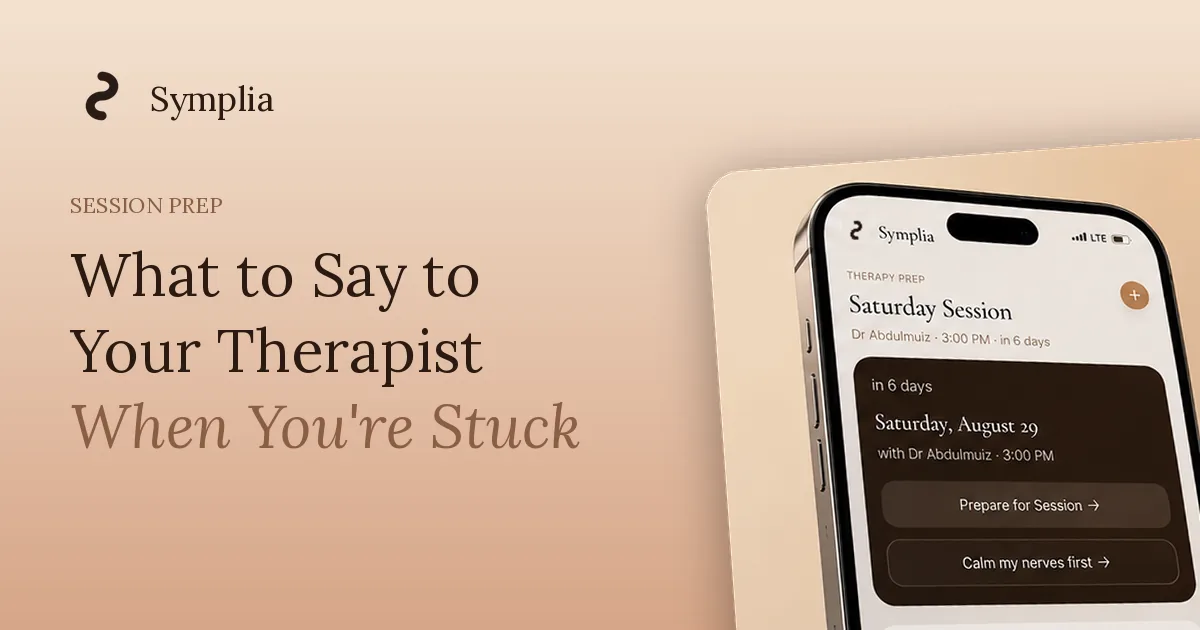
Symplia is built for this specific problem. The journal and Quick Log features are designed for fast capture throughout the week. The session prep section helps you review and organize before each appointment. Monthly and Annual plans include a 7-day free trial. Try Symplia at app.symplia.app.
Symplia helps you prepare for every therapy session with session prep, mood tracking, and journaling. Monthly and Annual plans include a 7-day free trial. Try Symplia at app.symplia.app.