There is a version of therapy where your therapist knows you well, not just from the session you are currently in, but from the week you have just lived through. They know what happened. They can meet you where you actually are rather than where you were two weeks ago.
Most people's therapy does not work like that. Most people's therapy works like this: you show up, you spend the first portion of the session reconstructing context, and you arrive at the actual work with diminishing time.
The difference is what the client brings in, and whether there is a system for bringing it.
Why context matters so much in therapy
Your therapist can only work with what you give them. The more specifically you share, the more specifically they can help.
"I've been struggling" gives them very little. "I noticed this week that I had an unusually strong reaction to criticism from my manager on Wednesday, and looking at my mood log I can see it follows a pattern from the previous two weeks" gives them something to work with.
Context is not just detail for its own sake. It is the thing that lets your therapist see connections you cannot see from inside the experience.
What to share and how
Before each session, a useful brief includes:
A mood summary from the week. Not a number, a sense. "Better than last week overall, with a rough patch mid-week" is enough.
The two or three most significant moments from the week. Not everything that happened, just the things that felt most relevant.
What you most want to work on today. This is the most valuable line because it tells your therapist how to allocate the session.
Anything that feels urgent or that you might avoid raising if not prompted.
That is four things. Takes five to ten minutes to prepare.
The prep note approach
Some therapists now receive brief prep notes from clients before sessions. If your therapist does not already receive prep notes, introduce it simply: "I've been preparing a brief note before sessions about what I want to cover. Would it help to send it to you in advance?" Most therapists respond positively.
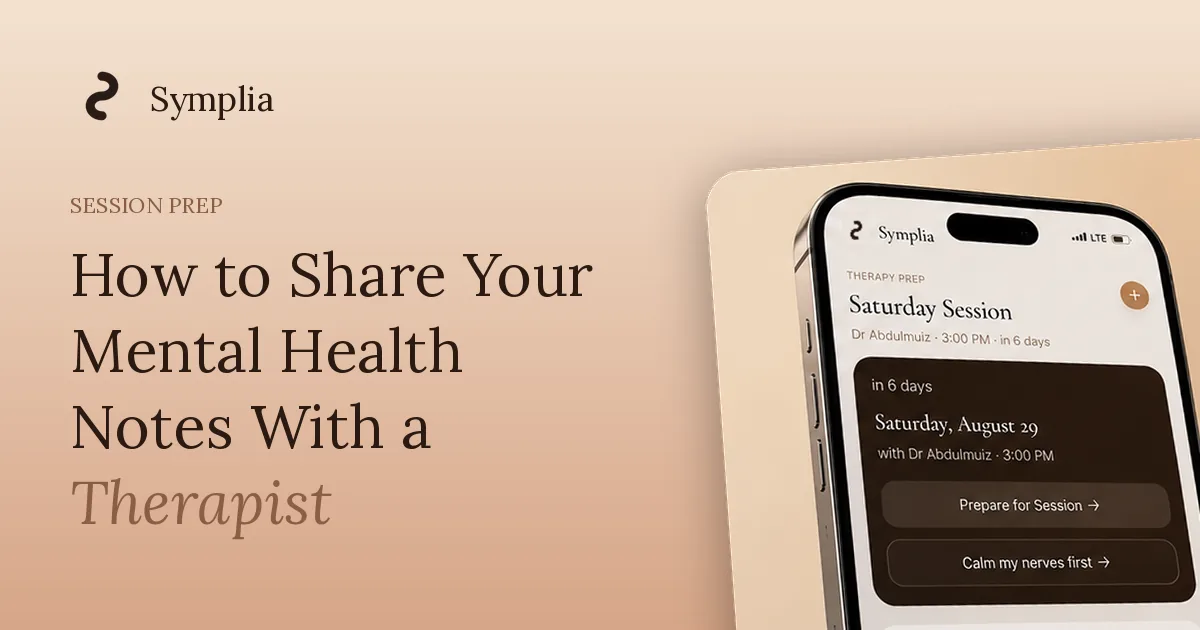
Symplia's upcoming Therapist Mode is built specifically for this workflow. Your therapist receives your session prep before the appointment, can see your mood trend from the week, and arrives oriented rather than orienting.
Progress over time
One of the most underused aspects of sharing with your therapist is sharing your sense of your own progress. Not just what is difficult, but what is getting easier.
Progress in therapy is easy to lose sight of because it is slow and because the difficult things remain salient longer than the improvements. Deliberately noting progress, in your own records and in what you bring to sessions, helps both you and your therapist see the trajectory.
"I noticed this week that I handled that situation differently than I would have six months ago" is one of the most valuable things you can say in a therapy session. It requires having paid attention to the week.
Monthly and Annual plans include a 7-day free trial. Try Symplia at app.symplia.app.
Symplia is a therapy companion app for journaling, mood tracking, and session prep. Monthly and Annual plans include a 7-day free trial. Try Symplia at app.symplia.app.