The best mental health journal app depends on what you want it to do. Day One suits people who want a private, polished place to write freely. Daylio suits people who want quick mood logging with minimal typing. Rosebud suits people who like AI-guided reflection prompts. Symplia is built for people in therapy who want journal entries and mood check-ins turned into a session note and a shareable report. This guide explains how to choose.
What a mental health journal app should do
A general diary app and a mental health journal app can look similar. The difference is what happens after you write. Before comparing apps, it helps to know what the evidence does and does not say about writing for wellbeing.
The research is more mixed than many app pages suggest. A 2006 meta-analysis of randomized trials of expressive writing, Mogk and colleagues in GMS Psycho-Social-Medicine, found minor or no overall effects on health, and an earlier meta-analysis it discusses had reported larger ones. A review of patient writing in psychotherapy describes the evidence for expressive writing as mixed, with few studies in people who have psychiatric diagnoses. In short, journaling is not a proven treatment. Many people still find it useful as a way to slow down, notice patterns and bring clearer thoughts to the people who support them.
Writing is also a normal part of structured therapy. An NHS Talking Therapies service offers the thought journal as a self-help exercise, suggesting you start from a recent difficult situation, and points people to local talking therapy if worry, stress or negative thinking is getting in the way of life.
On the app side, the US National Institute of Mental Health says in Technology and the Future of Mental Health Treatment that apps can reinforce skills between sessions, but that there is very little industry regulation and most apps lack peer-reviewed research behind their claims. It also asks how an app maker guarantees privacy.
Using those sources as a guide, look for these things:
- Low friction. If an entry takes more than a couple of minutes on a hard day, you will stop.
- Context with the writing. Mood, sleep or what happened that day makes entries easier to interpret later.
- A way to use what you wrote. Searching, reviewing or summarizing entries matters more than storing them.
- Clear privacy controls. Encryption, passcodes, export and a readable privacy policy.
- Honest limits. A good app does not claim to diagnose or replace a clinician.
The best mental health journal apps compared
Day One
Day One is a general journaling app rather than a mental health app, and it does that job well. Its site lists apps for iPhone, iPad, Mac and Apple Watch, plus Android, Windows and web browsers. It highlights end-to-end encryption, passcode and biometric security, automatic backups and the ability to export your data. Entries can include photos, video, drawings and audio, and an On This Day feature lets you revisit past entries. The app is described as free to use, with a paid Gold plan; check their site for what Gold includes and its current price.
Best for: people who want a private, well-designed place to free-write across devices.
Limits: it is a container for your writing. It does not offer therapy-specific structure, so you bring your own method.
Daylio
Daylio is a mood and activity diary that works through quick taps instead of long writing. Its help centre covers iOS and Android and refers to a Premium tier and backup options; check their site for the current free versus Premium split and for pricing.
Best for: people who find writing hard when they feel low and prefer a quick check-in habit.
Limits: quick tags capture how often something happens but not why. If you want to write at length or prepare for therapy, you may want a second tool. Our comparison Symplia vs Daylio and the guide to Daylio alternatives for therapy clients cover that gap in more detail.
Rosebud
Rosebud is an AI-assisted journal. Its site describes writing or speaking your thoughts, personalized reflection prompts, guided and custom journals, and weekly reflection reports that highlight patterns. It is available on iOS and Android, with a web option. The site says it is free to use and lists a paid plan with a free trial; monthly pricing has been listed at $12.99, but check their site as pricing changes. It describes data as encrypted in transit and at rest and shows a "HIPAA aligned" badge. Read their privacy policy to see what that means for your own data, because a badge is not a guarantee. The site speaks of emotional support and does not present the app as therapy.
Best for: people who like being asked questions and want reflection prompts when the blank page feels hard.
Limits: AI prompts and summaries are not clinical judgment. If you use an AI journal, read our piece on AI journaling for mental health first.
Symplia
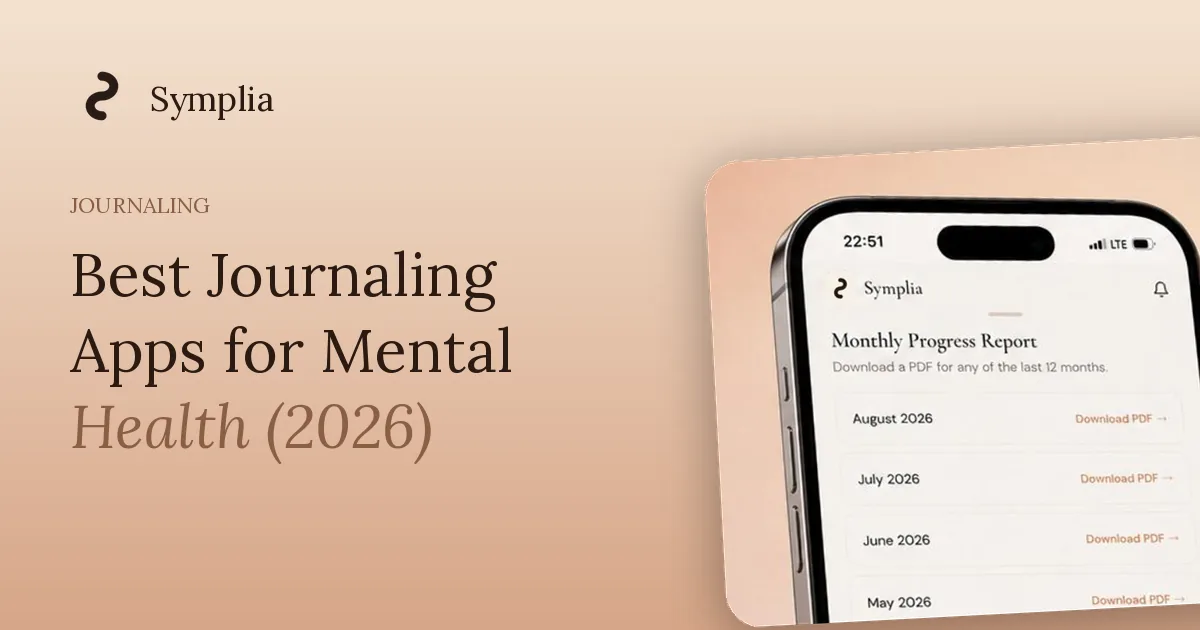
Symplia is our app, so weigh this entry with that in mind. It is a private mental health app for tracking, journaling and reflection, designed around therapy rather than general diary use. The journal supports free writing, prompts, a Voice Journal, Unsent Letters for things you do not plan to send, and Thinking Traps for spotting unhelpful thought patterns. Mood check-ins let you add context, and AI-assisted insights help you notice recurring themes without diagnosing anything. For therapy, Session Prep and Therapy Work organize what you want to raise, and a shareable therapist report lets you choose what to show.
Symplia is a web app today at app.symplia.app, with iOS and Android versions coming soon. Plans are Weekly at $4.99, Monthly at $12.99 or Annual at $79, with a 7-day free trial on Monthly and Annual. Every plan includes every feature; see pricing for the current details.
Best for: people in therapy who want their writing and mood notes to feed into sessions.
Limits: it is not a meditation or habit-building app, it is not therapy, and it is not a crisis service. If you want a simple diary with native apps on every device right now, Day One is a stronger fit for that single job.
Other apps people ask about
Journey, Stoic, Finch and Bearable also come up often in searches. Check their own sites for platforms, pricing and privacy details before choosing, and apply the same checks below.
Is there a therapy journal app?
Yes, but the term covers two different needs. Some people want a journal to process feelings on their own. Others want a tool that supports the work they do with a therapist. A therapy journal app leans toward the second.
What makes an app therapy-friendly in practice:
- Capture between sessions. Short entries or voice notes on the day something happens, not a week later.
- Prompts rooted in therapy work. For example, thought records of the kind the NHS service above describes.
- A pre-session summary. A short list of what to raise, which you can bring to the room. See how session prep works.
- Choice over sharing. You decide what your therapist sees, if anything.
Always ask your therapist how they would like to use any notes. Some enjoy a written summary; others prefer you to simply talk. For a deeper look at tracking, see the guide to the best mood tracking app for therapy clients and our mental health journal page.
Privacy checks before you write anything
Journals hold some of the most personal things you will ever type. NIMH raises privacy as a core question for any mental health app, so check these before you commit:
- Who can read your entries? Look for encryption statements and what the company says about staff access.
- Is there a passcode or biometric lock? This protects you on a shared or lost phone.
- Can you export and delete your data? You should be able to leave with your writing.
- Is data used for advertising or training? The privacy policy should say plainly.
- Do you recognize the claims? Terms such as "HIPAA aligned" or "secure" need a policy behind them.
Our mental wellness app privacy checklist goes deeper, and Symplia's own approach is on the privacy page.
How to pick in five minutes
- Name the job. Free diary, quick mood log, guided reflection or therapy support.
- Match the job. Day One for a diary, Daylio for quick logging, Rosebud for AI prompts, Symplia for therapy prep.
- Check privacy. Spend one minute on the checklist above.
- Try it for a week. Use a free tier or trial and note whether you actually opened it on a hard day.
- Keep only one. Two journaling apps usually means neither gets used.
When to get support
A journal can help you reflect, but it cannot replace care. NIMH advises seeking help for severe or distressing symptoms that last two weeks or more, such as trouble sleeping, changes in appetite, difficulty getting out of bed or losing interest in things you enjoy. If you are struggling, contact a licensed mental health professional. If you may be in danger or thinking about harming yourself, contact your local emergency services or a crisis line in your country right away.
Sources and further reading
- Technology and the Future of Mental Health Treatment - NIMH on benefits, limits, privacy and the evidence for apps.
- Caring for Your Mental Health - NIMH on when to seek professional help.
- Health effects of expressive writing on stressful or traumatic experiences: a meta-analysis - Mogk et al., 2006, on the limited overall effects found.
- Using Patient Writings in Psychotherapy - review describing mixed evidence for expressive writing.
- Have you tried creating a thought journal? - NHS Talking Therapies page on the thought journal exercise.
Where Symplia fits
Symplia is for people who want journaling, mood check-ins and therapy preparation in one private place, and who are comfortable using a web app while the iOS and Android apps are on their way. It is not a replacement for a general diary or for professional care. Many people use it alongside therapy rather than instead of it.
Try Symplia free at app.symplia.app. Monthly and Annual plans include a 7-day free trial.
Frequently asked questions
What is the best mental health journal app?
It depends on your goal. Day One is a strong private diary, Daylio is built around quick mood logging, Rosebud offers AI-guided prompts, and Symplia focuses on journaling that supports therapy.
Is there a good therapy journal app?
Look for an app that lets you capture thoughts between sessions, summarize them before an appointment and choose what to share. Symplia is designed for this, and you can also use a general journal and bring notes to sessions yourself.
Does journaling help mental health?
Research is mixed. A 2006 meta-analysis found minor or no overall effects from expressive writing, though many people find journaling helps them reflect and prepare for conversations. It is not a treatment on its own.
Are mental health journal apps private?
It varies by app. Check for encryption, passcode lock, export and delete options, and a clear privacy policy before you write anything sensitive.
Should I show my journal to my therapist?
Only if you want to, and it is worth asking your therapist how they prefer to use notes. A short summary of themes is often easier to use than full entries.
Can a journal app replace therapy?
No. Apps can reinforce skills between sessions, but NIMH notes there is little regulation or evidence for many of them. If symptoms are severe or last for weeks, speak with a licensed professional.