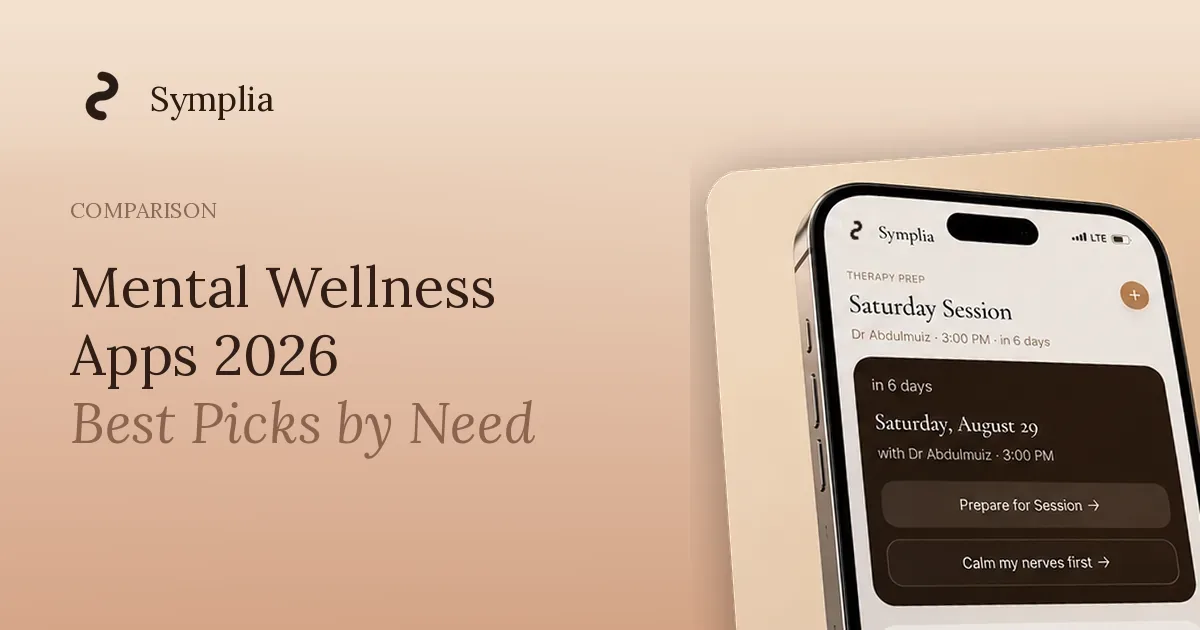
The best mental wellness apps depend on what you need, not on a single winner. Journaling apps such as Day One suit reflection, Daylio suits quick mood tracking, Headspace suits meditation and sleep, Talkspace connects you with licensed therapists, and Symplia suits people who want journaling, mood context and session prep alongside therapy. Most mental wellness apps support care rather than replace it, so match the tool to the job.
How mental wellness apps differ
"Mental wellness app" covers very different products. Some help you notice patterns, some teach relaxation skills, and some are a way to book a licensed professional.
The National Institute of Mental Health (NIMH) notes that apps can complement traditional therapy and that an app may not replace a mental health professional. It also points out that most apps do not have peer-reviewed research behind their claims, which is why this guide sticks to what each company says it does and asks you to test an app for a few days before committing.
This guide groups apps by need:
- Journaling and reflection
- Mood tracking
- Meditation and sleep
- CBT-style self-help
- Therapy access
Pricing changes often, so check each company's site.
Journaling and reflection
Writing helps many people sort through tangled thoughts, and a good journaling app mostly needs to be easy to open and pleasant to write in. If you want a deeper comparison, see our guide to the best journaling apps for mental health and our explainer on AI journaling for mental health.
Day One
Day One is a general-purpose journal. Its site lists apps for iPhone, iPad, Apple Watch, Mac, Android and Windows, plus a web version, and describes end-to-end encryption, passcode and biometric protection, automatic backups and export at any time. Features include "On This Day" (which resurfaces past entries), photos, video, audio and drawings, and calendar and timeline views. The app is described as free to use, with a paid Gold plan; check Day One's site for what Gold costs and includes.
Best for: people who want a beautiful, flexible, long-term diary and care about cross-device access. It is not built around therapy or mood analysis, so it works best if you already know what you want to write about.
Mood tracking
Mood tracking turns "I have been feeling off" into something you can look back on. It is useful when you want a fast daily check-in instead of a blank page. For more on how the two approaches compare, read mood tracking vs journaling and our overview of the mental health tracker.
Daylio
Daylio is built around quick taps: pick a mood, choose the activities from your day, and optionally add a note. According to its help center, it has a free version that you can keep using without losing data, and a premium tier with a 7-day trial. Premium listings include expanded statistics, unlimited reminders, automatic backups, PDF export, more icons and themes, and an iOS PIN lock. The help center does not list prices and points users to the app for current pricing.
Best for: people who want a low-effort daily log and simple statistics. If you are weighing it against a more reflective option, see Symplia vs Daylio.
Meditation and sleep
Meditation, breathing and sleep apps focus on helping you relax and rest. NIMH lists sleep, relaxation and a consistent routine among its self-care suggestions in its guidance on caring for your mental health, and notes that relaxation programs may include meditation, muscle relaxation or breathing exercises.
Headspace
Headspace describes itself as a guide to mental health, mindfulness and meditation. Its App Store listing mentions more than 500 guided meditations (from a few minutes to longer sessions), breathwork, sleep sounds, sleepcasts and sleep music, focus music, mindful movement, progress tracking and daily reminders. The app is free to download with in-app purchases and a free trial; the UK listing showed monthly and annual prices, and prices vary by country, so check Headspace before subscribing.
Best for: people who want guided calm, a wind-down routine or a way into meditation. It is a skills and relaxation tool rather than a journal or a record of your patterns over time.
CBT-style self-help
Cognitive behavioral therapy (CBT) is a structured approach that looks at the links between thoughts, feelings and behavior. Self-help tools inspired by it usually ask you to notice a thought, check it against the evidence and try a more balanced view. These tools can be useful practice, but they are not the same as CBT delivered by a trained clinician.
If you want a worksheet-style approach, start with our guide to the CBT thought record and our roundup of CBT apps without subscription traps. When comparing any app in this category, check three things:
- Does it say who built it and what their credentials are?
- Does it explain what to do if symptoms worsen or there is an emergency?
- Does it make clear that it is not therapy?
Symplia includes a Thinking Traps tool in its journal that helps you spot common thought patterns, but it is a reflection aid and does not deliver CBT or any treatment.
Therapy-access platforms
Sometimes an app is not what you need, a person is. Therapy-access platforms connect you with licensed professionals through video, voice or messaging.
Talkspace
Talkspace's site describes therapy with licensed therapists by video, voice or live chat, messaging with your therapist, and online psychiatry for evaluation and medication management (therapists cannot prescribe). It says it is in-network with many major insurers, that many insured members pay a low or zero copay depending on their plan, and that out-of-pocket plans start from a weekly price. Eligibility, availability and cost depend on your plan and location, so confirm details on Talkspace's site and with your insurer.
Best for: people who want ongoing care from a licensed clinician and prefer to arrange it online. If cost is the question, our therapy cost calculator can help you plan, and the free vs paid wellness apps guide explains the trade-offs of subscriptions.
Symplia: therapy-adjacent journaling
Symplia is a private mental health app for journaling, mood check-ins with context, and preparing for and following up on therapy. In plain terms, it sits between a journal and a therapy notebook. It is not therapy, does not diagnose, is not an emergency service and is not a meditation app.
What it offers:
- A journal with free-writing, prompts, Voice Journal, Unsent Letters and Thinking Traps
- Mood check-ins that capture context, plus a Year in Pixels view
- AI-assisted insights that help you notice recurring themes (not a diagnosis)
- Session Prep, Therapy Work, a Letter to Therapist and a shareable therapist report where you choose what to share
- A monthly progress report PDF
Symplia is a web app today at app.symplia.app, with iOS and Android versions coming soon. Plans are listed on the pricing page. Every plan includes every feature, and the Monthly and Annual plans include a 7-day free trial.
Best for: people in therapy, or thinking about it, who want to arrive at sessions with clearer notes. To understand the category, read what a therapy companion app is.
How to choose a mental wellness app
Start with the need, then check the basics:
- Name the job. Do you want to reflect, track, relax, learn skills or see a clinician? One app rarely does all five well.
- Check privacy. NIMH lists privacy as an open concern, since many apps handle sensitive personal information. Read the privacy policy, look at what data is shared and whether you can export or delete it. See our mental wellness app privacy checklist.
- Look at the evidence honestly. NIMH says most apps lack peer-reviewed research for their claims and that there are no national standards for judging effectiveness. NIMH suggests checking the developer's credentials, searching PubMed for supporting research, and noting that NIMH itself does not endorse any apps.
- Look for crisis information. A responsible app explains what to do if you feel worse or are in an emergency.
- Try it for a few days. NIMH suggests testing an app to see whether it is easy to use and keeps your interest. If you stop opening it, it is not working for you, whatever the reviews say.
When to get support
Apps are useful tools, but they are not a substitute for care. NIMH advises seeking professional help for severe or distressing symptoms lasting two weeks or more, such as sleep problems, loss of interest, trouble concentrating or difficulty handling usual tasks. A primary care provider can refer you to a mental health professional.
If you are thinking about harming yourself or are in immediate danger, contact your local emergency services or a crisis line in your country right away.
Sources and further reading
- Technology and the Future of Mental Health Treatment (NIMH) - supports the points on apps complementing therapy, limited peer-reviewed evidence, privacy concerns and how to evaluate an app.
- Caring for Your Mental Health (NIMH) - supports the self-care, sleep and relaxation guidance and when to seek professional help.
- Daylio Premium Features (Daylio help center) - supports the free tier, 7-day trial and premium feature list.
- Headspace: Meditation & Sleep (App Store) - supports the Headspace feature and subscription details.
- Day One - supports the platform, encryption and feature details.
- Talkspace - supports the therapy, psychiatry and insurance details.
Where Symplia fits
Use a meditation app to unwind, a mood tracker for a quick daily log, and a therapist for treatment. Symplia fits in the gap between sessions: a private place to write, check in on mood with context, and turn the week into notes you can bring to therapy.
Try Symplia free at app.symplia.app. Monthly and Annual plans include a 7-day free trial.
Frequently asked questions
What are the best mental wellness apps in 2026?
It depends on the need. Day One suits journaling, Daylio suits quick mood tracking, Headspace suits meditation and sleep, Talkspace suits access to licensed therapists, and Symplia suits therapy-adjacent journaling and session prep.
Can mental wellness apps replace therapy?
No. NIMH describes apps as something that can complement traditional therapy, and notes an app may not replace a mental health professional. If your symptoms are severe or last two weeks or more, speak with a licensed professional.
Are mental wellness apps backed by research?
Some are, but many are not. NIMH says most apps do not have peer-reviewed research to support their claims, so look for named studies and the developer's credentials.
Are free mental wellness apps good enough?
Many people find free tiers enough for basic journaling or mood tracking. Paid plans usually add features such as backups, export or more content, so compare what you will actually use. See our guide to free vs paid apps.
Is Symplia a meditation or therapy app?
No. Symplia is a journaling, mood check-in and therapy-support app. It is not therapy, not a diagnostic tool and not a meditation app.
Is Symplia available on iPhone and Android?
Symplia is a web app today at app.symplia.app, and iOS and Android apps are coming soon.