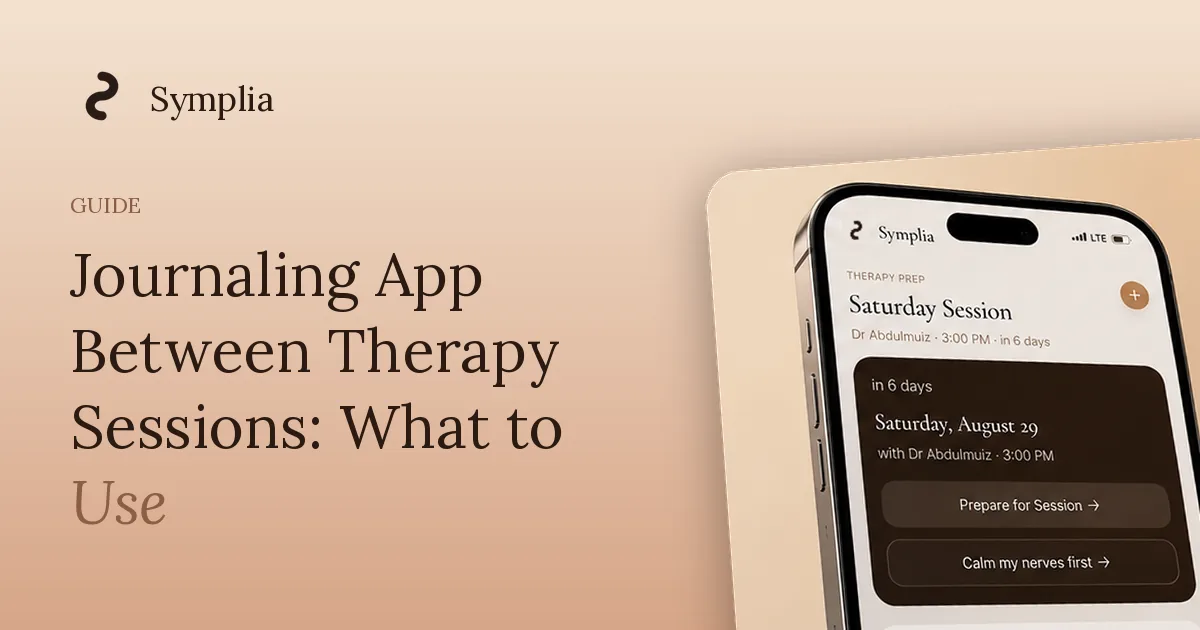
The best journaling app to use between therapy sessions is one that makes writing easy on a bad day, keeps your entries private, and helps you carry insights into your next appointment. General journals such as Day One are flexible and well made. A therapy-focused option such as Symplia adds session prep, prompts and a shareable report. Pick based on whether you want a free-form diary or a bridge to your sessions.
This guide explains how journaling helps between sessions, what to look for, and a routine that fits into a busy week.
Why journal between therapy sessions
Therapy usually happens in short, scheduled windows, often weekly or less. The rest of your life happens in between. Many people leave a session with clear insight and lose it within a few days. Journaling can help by:
- Capturing things while they are fresh, instead of trying to remember them a week later.
- Slowing down your thinking, so you can see a worry on the page rather than looping on it.
- Showing patterns, such as the same trigger or thought appearing across entries.
- Giving you material for sessions, so you do not spend the first twenty minutes working out what to say.
Journaling does not replace therapy, and there is no right way to do it. Many people find even short entries useful.
What to look for in a journaling app
- Privacy. A passcode or biometric lock, and a clear explanation of how data is stored. Journals can be very personal.
- Low friction. If starting takes effort, you will not do it when you are tired or upset. Voice entries and prompts help here. See voice journaling and mental health.
- Prompts for when you are stuck. A good prompt shrinks a big question into a small one. Our journal prompts page has examples.
- A way to flag important moments so you can find them before a session.
- Easy review. Searching or looking back is where patterns appear.
- Sharing on your terms. If you want to show your therapist something, you should choose what.
Options to consider
Day One
Day One's site describes a journaling app with photos, video, drawings and audio, "On This Day" reminders, passcode and biometric protection, end-to-end encryption, and export. It runs on iPhone, Android, iPad, Mac and the web, with a free tier and a paid Gold plan (see their site for pricing).
Suits best: people who want a polished, flexible, general-purpose journal. Worth knowing: it is not designed around therapy, so you will build your own system for session prep.
Paper journals
A notebook has no lock screen, no subscription and no notifications. Many people think better with a pen. Suits best: people who want zero tech. Worth knowing: it is harder to search, and it can be awkward to bring to a session.
Symplia
Symplia is a private mental health app with a journal that supports free-writing, prompts, Voice Journal, Unsent Letters and Thinking Traps. Mood check-ins include context, and Session Prep helps you turn the week into what you want to discuss. Therapy Work tracks what you are practising between appointments, and you can create a shareable therapist report, choosing what to include. Insights help you notice recurring themes and are not a diagnosis. It is a web app now, with iOS and Android coming soon.
Suits best: people in regular therapy who want writing connected to sessions. Worth knowing: it has more structure than a blank diary, which some people love and others find unnecessary.
For a wider comparison, see best journaling apps for mental health in 2026.
A simple between-session routine
You do not need a long daily habit. Try this:
- Within 24 hours of a session, write five minutes on what stood out and one thing you want to try. Our guide to post-session therapy journaling covers this.
- Two or three times during the week, write a short entry on whatever felt big. One line counts.
- When something bothers you, write what happened, what you thought and what you felt.
- A day before the next session, read back and mark the three things you most want to raise.
- Bring the list or a short summary, and start the session with it.
If you are not sure what to write, the 20 journal prompts for when you do not know what to write are a good place to start.
Tips for keeping it going
- Attach it to an existing habit, like tea or brushing your teeth.
- Do not catch up on missed days. Start again with today.
- Shorten entries rather than stopping.
- Write in whatever format feels easiest: typing, voice or paper.
- Do not edit. Messy entries are still useful.
What not to expect
Journaling is not a substitute for therapy. It can make hard feelings more visible, and sometimes that is uncomfortable. If writing brings up distress that feels overwhelming, pause, use a grounding strategy you have learned, and tell your therapist.
When to get support
If you are thinking about harming yourself or feel unsafe, contact a licensed mental health professional, your local emergency services or a crisis line in your country right away. An app is not an emergency service.
Where Symplia fits
Symplia is built for the gap between sessions: a private place to write, track and prepare so your appointments start with material, not a blank page. It is not therapy and does not replace a licensed professional. Every plan includes every feature; see the pricing page.
Try Symplia free at app.symplia.app. Monthly and Annual plans include a 7-day free trial.
Frequently asked questions
What is the best journaling app for therapy?
It is the one you will use and that fits your needs. A general journal such as Day One suits free writing, while a therapy-focused app such as Symplia adds session prep and sharing.
How often should I journal between sessions?
A few short entries a week is a realistic start, with a longer one after sessions and before the next. Daily is fine if it feels good.
Should I show my journal to my therapist?
You decide. Many people share a summary or selected entries instead of everything. Your therapist can tell you what is useful.
Is it safe to keep a journal in an app?
Look for a lock, clear data practices and a privacy policy you understand. Check each app's privacy page before storing sensitive material.
What if I do not know what to write?
Use a small prompt, write one line, or speak instead of typing. A short honest entry is enough.
Can journaling replace therapy?
No. It can support therapy, but it does not replace care from a licensed professional.