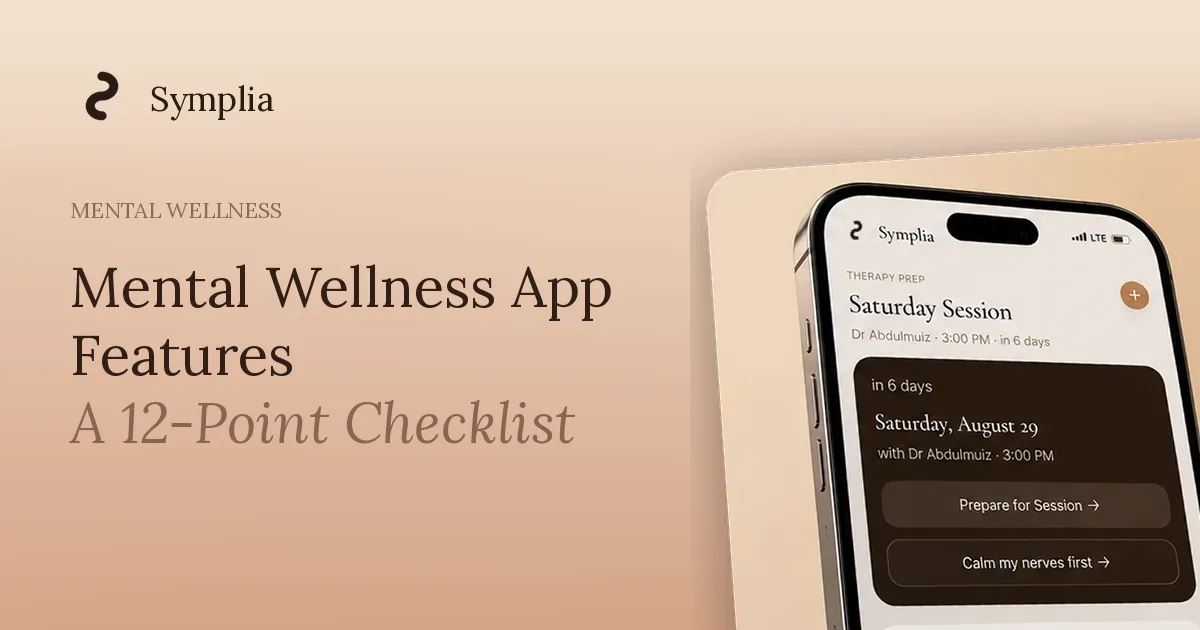
The mental wellness app features that matter most are clear privacy terms, an evidence basis you can check, visible crisis resources, easy data export and deletion, and honest pricing. Nice extras such as offline use, mood tracking, journaling and therapist sharing depend on what you need. Use the 12 points below as a checklist before you commit. If an app fails on privacy or safety, no amount of polish makes up for it.
Why a checklist helps
There are thousands of mental wellness apps, and the store listings all sound similar. The US National Institute of Mental Health suggests asking several questions before using one: whether there is research behind it, how the maker protects your privacy, what the app says to do if symptoms worsen or there is a psychiatric emergency, who built it, and whether you want a fully automated app or one with a trained professional. NIMH also recommends testing an app for a few days to see if it is easy to use and holds your interest. The checklist below turns those questions into something you can score.
The 12-point checklist
Trust and safety
- A clear, readable privacy policy. You should be able to find out what is collected, who it is shared with and whether it is used for advertising. In its 2023 review of 32 mental health apps, the Mozilla Foundation flagged 19 with a privacy warning label, so it is worth reading before you type anything personal. Our privacy checklist goes deeper.
- No selling or sharing of your data for ads. Look for plain language, not vague phrases such as "partners" or "affiliates."
- An evidence basis you can verify. Ideally the app is based on a tested approach such as CBT, or is itself studied in trials. A 2024 meta-analysis of 176 trials in World Psychiatry found small but significant effects for apps on depression and generalized anxiety, so be wary of big promises. Marketing words like "clinically proven" should come with a link to the proof.
- Visible crisis resources. The app should say what to do in an emergency and point you to local emergency services or a crisis line. It should also be honest that it is not an emergency service.
- Honest claims. An app that says it can diagnose, treat or cure you deserves caution. Good apps say what they are not.
Control over your data
- Export your data. You should be able to download your entries and mood history in a usable format, so your words are not locked in.
- Delete your data and account. Check that deleting is possible from inside the app or through a simple request, and that the policy says what happens to the data afterwards.
- Control over sharing. If an app lets you share with a therapist or a person you trust, you should choose what is shared, not hand over everything.
Everyday usefulness
- Pricing transparency. The price, the billing period, the trial terms and how to cancel should all be clear before you pay. Read free vs paid mental wellness apps for what to expect at each level, and check each company's site because pricing changes.
- Tracking that is simple enough to keep up. A check-in that takes under a minute is more likely to become a habit. A good mental health tracker lets you add context, not only a number, so you can see what sits behind a low day.
- Journaling that suits how you think. Some people like free-writing, some like prompts, and some prefer speaking. The tool should fit your style. You can try a few journal prompts before choosing.
- Reliable offline or low-signal use. If you write on trains, in hospitals or in places with weak signal, check whether entries are saved and synced later. Not every app offers this, so ask or test it during a trial.
Features that sound good but need a closer look
- AI insights. Useful when they help you notice recurring themes, but they are not a diagnosis. Check whether your entries are sent to third parties to produce them.
- Streaks and badges. They can motivate some people and add guilt for others. If missing a day makes you feel worse, switch them off or pick a gentler app.
- Chat companions. Fine for some uses, but check how the app handles crisis messages and whether it is clear that it is not a therapist.
- Free with heavy ads. Ads in a mental health context can mean extra tracking. See point 1.
How to test an app in 20 minutes
- Read the privacy policy summary and find the delete-account option.
- Open the app and look for crisis information.
- Make one entry and one mood check-in.
- Try to export your data.
- Look at the pricing page and the cancellation instructions.
- Come back the next day and see if you want to open it again.
If it passes, give it a week. If not, move on. Our overview of the best mental wellness apps in 2026 can help you shortlist.
When to get support
An app can help you notice and organise what you are feeling, but it cannot assess risk or provide treatment. If you feel unsafe, have thoughts of harming yourself or are struggling to cope, contact a licensed professional, your local emergency services or a crisis line in your country.
Sources and further reading
- Technology and the Future of Mental Health Treatment (NIMH) - questions to ask before using a mental health app, and the lack of peer-reviewed evidence for most apps.
- Shady Mental Health Apps Inch Toward Privacy and Security Improvements, But Many Still Siphon Personal Data (Mozilla Foundation, 2023) - privacy warning labels on 19 of 32 reviewed apps.
- Current evidence on the efficacy of mental health smartphone apps for symptoms of depression and anxiety: A meta-analysis of 176 randomized controlled trials - small but significant effects on depression and generalized anxiety.
Where Symplia fits
Symplia is a private mental health app for tracking, journaling, reflection and therapy support. It offers a journal with prompts and Voice Journal, mood check-ins with context, Session Prep, and a shareable therapist report where you choose what to share. Pricing is Weekly $4.99, Monthly $12.99 or Annual $79 in USD, and every plan includes every feature. Please check the pricing page for current details. It is not therapy, not diagnostic and not an emergency service.
Try Symplia free at app.symplia.app. Monthly and Annual plans include a 7-day free trial.
Frequently asked questions
What is the most important feature in a mental wellness app?
Privacy and safety come first: a clear privacy policy, honest claims and visible crisis resources. Features such as tracking and journaling only matter if you can trust the app with the information you put in.
How can I tell if a mental wellness app is evidence-based?
Look for a link to published research, or a basis in a tested approach such as CBT. NIMH notes that most apps lack peer-reviewed support for their claims, so be sceptical of vague phrases like "science-backed" with no source.
Should a mental wellness app let me delete my data?
Yes. You should be able to export and delete your data, and the privacy policy should explain what happens after deletion. If you cannot find this, ask the company before you sign up.
Do I need an app that works offline?
Only if you often write without a signal. It is a convenience, not a safety feature, but it can decide whether you keep a habit going.
Are free mental wellness apps worth using?
Some are, especially for trying out journaling or tracking. Check how they make money, since ads and data sharing are common in free products.
Can an app replace a therapist?
No. Apps can support your wellbeing and make therapy more useful, but they do not replace a licensed professional.