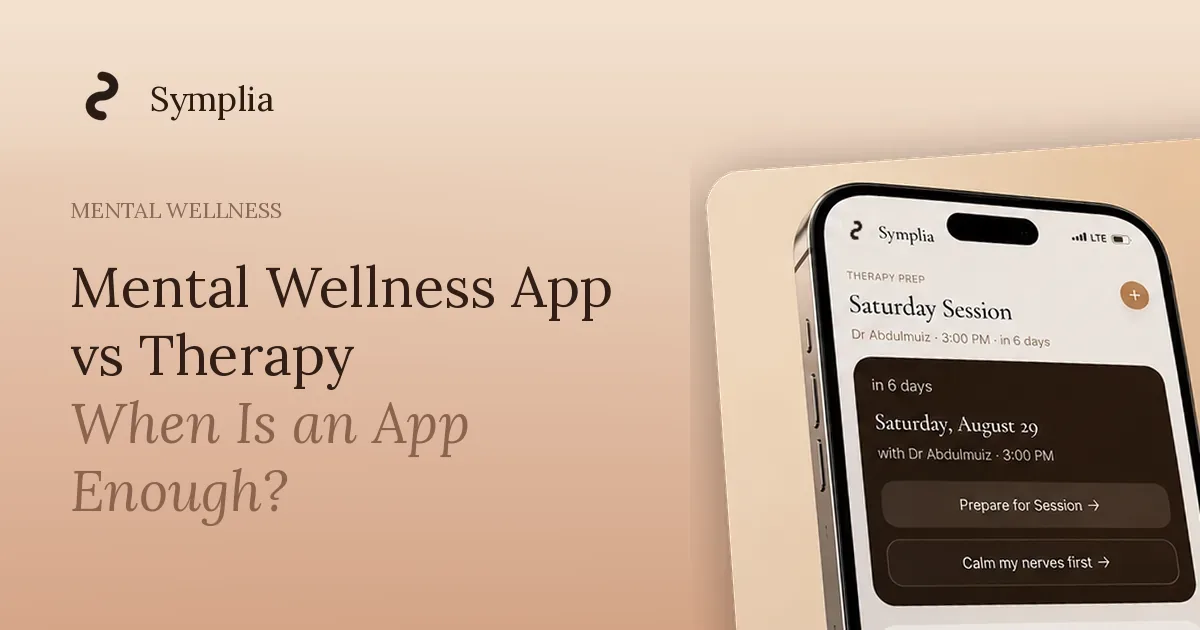
A mental wellness app can be enough when you are dealing with everyday stress, low-level worry or a wish to understand yourself better, and you are still functioning day to day. It is usually not enough when symptoms are severe, getting worse, affecting work, school or relationships, or involve thoughts of harming yourself. Research suggests apps tend to have small effects on their own, and many health systems use them as a lighter first step, not a replacement for a professional.
What the evidence says about apps and therapy
The honest summary is that apps help some people a little, and therapy helps more people more. A 2024 meta-analysis of 176 randomized controlled trials in World Psychiatry (Linardon and colleagues) found small but significant effects of mental health apps on depression and generalized anxiety symptoms compared with control groups. The authors describe the overall effects as small, and effects were larger for apps with CBT features or mood monitoring in some analyses.
The US National Institute of Mental Health makes a similar point. It says apps can complement traditional therapy by extending in-person sessions, reinforcing skills and providing monitoring between visits, but also that most apps do not have peer-reviewed research to support their claims. For a fuller look at the trials, see do mental health apps work?.
What this means in practice:
- An app is a tool, not a treatment plan.
- Results vary a lot by app, by condition and by how consistently you use it.
- A tool that supports therapy is better supported by the research than a tool that tries to stand in for it.
When a mental wellness app can be enough
An app may be a reasonable place to start if most of these are true:
- Your stress, worry or low mood is real but manageable, and you are sleeping, eating and getting through your days.
- You want to build a habit such as journaling, checking in with your mood or practising breathing.
- You want to notice patterns before deciding whether to see someone.
- You are on a waiting list or cannot afford therapy right now and want something useful in the meantime.
- You have no history of severe symptoms, or you have a care team and are using the app alongside them.
In these situations, simple tools tend to work best. Writing a few honest lines with journal prompts, tracking your mood for a few weeks, or running a quick mental wellness check can show you whether things are stable, slowly sliding or improving.
What stepped care means and why it matters
Stepped care is a model where people start with the least intensive option likely to help, and move to more intensive care if they need it. In England, NICE's guidance on digitally enabled therapies for depression describes them as a form of guided self-help within NHS Talking Therapies. NICE says these should be considered first for most people with less severe depression, because they are the least intrusive and least resource-intensive option. For more severe depression, treatments with more therapist contact should be considered first.
Two details are worth noticing. First, the digital therapies in that model are supported by a trained practitioner who encourages completion and reviews progress. That is different from downloading an app and using it alone. Second, a healthcare professional is expected to monitor things like side effects and suicidal thoughts. A general wellness app cannot do that for you.
When an app is not enough
Consider seeing a licensed professional, not only an app, if any of these apply:
- Symptoms have lasted more than a couple of weeks and are getting worse, or are stopping you from working, studying or looking after yourself.
- You have panic attacks, intrusive memories of a frightening event, or thoughts and behaviours that feel out of your control.
- You are using alcohol, drugs or food in ways that worry you.
- Self-help has not changed anything after a fair try.
- You have a diagnosed condition and are thinking of using an app instead of your treatment plan.
- You have a history of trauma and feel overwhelmed when you try to reflect on it alone.
You do not need to be in crisis to see a therapist. If you are weighing it up, how to find a therapist: a checklist walks through credentials, fit and cost.
When to get support right now
If you are thinking about harming yourself or feel you may be in danger, please contact local emergency services or a crisis line in your country straight away. The NIMH contact page directs people in the US who are in life-threatening situations to emergency services, and to the 988 Suicide & Crisis Lifeline for emotional distress. If you are elsewhere, search for your national crisis service. A wellness app, including Symplia, is not an emergency service.
How to use an app and therapy together
You do not have to choose. Many people get more from therapy when they bring something concrete to sessions. A few ways to do that:
- Log your mood briefly each day so you can describe the week accurately, not just the last two days.
- Write down what you want to raise before each session.
- Note what you tried between sessions and how it went.
- Share what is useful with your therapist, and keep private what is not.
This is the idea behind a therapy companion app: it supports the work between sessions without pretending to be the session.
A quick way to decide
Ask yourself three questions:
- Is this getting worse, or staying about the same for more than a few weeks?
- Is it interfering with daily life?
- Do I feel safe?
If the answer to the first two is yes, or the answer to the third is no, talk to a professional. If things feel manageable, try an app for a few weeks, check in with yourself, and reassess. For a wider look at options, see our guide to the best mental wellness apps in 2026.
Sources and further reading
- Current evidence on the efficacy of mental health smartphone apps for symptoms of depression and anxiety: A meta-analysis of 176 randomized controlled trials - small but significant effects of apps on depression and generalized anxiety.
- Technology and the Future of Mental Health Treatment (NIMH) - apps can complement therapy, and most lack peer-reviewed evidence.
- NICE: digitally enabled therapies for depression in adults, "The technology" - digital guided self-help within stepped care and who it suits.
- Contact Us (NIMH) - emergency and crisis line guidance.
Where Symplia fits
Symplia is a private mental health app for tracking, journaling and reflection, with Session Prep, Therapy Work and a shareable therapist report that you control. It is designed to sit alongside therapy, or to help you prepare for it, not to replace it. It is not therapy, not a diagnostic tool and not an emergency service.
Try Symplia free at app.symplia.app. Monthly and Annual plans include a 7-day free trial.
Frequently asked questions
Can a mental wellness app replace therapy?
For most people with significant or worsening symptoms, no. Research shows small effects for apps on their own, and organisations such as NIMH describe them as a complement to therapy. For mild, everyday stress, an app may be a reasonable first step.
Is an app better than nothing if I cannot afford therapy?
Often yes, as long as it is safe and you stay realistic about what it can do. Journaling, mood tracking and skills practice are low-risk ways to support yourself while you look for affordable care.
Are apps with a human coach more effective?
In NICE's stepped care model, digital therapies are supported by a trained practitioner, which is part of how they are used in the NHS. Support from a person can help people keep going, but check what qualifications the person has.
How long should I try an app before deciding it is not enough?
A few weeks of consistent use is a fair test. If symptoms are not improving, are getting worse, or are affecting daily life, speak to a licensed professional.
Can I use an app while I am in therapy?
Yes, and many people find it helpful for tracking mood, preparing for sessions and noting what came up afterwards. Tell your therapist what you are using.
What if I am not sure whether I need therapy?
A short self-check can help you see how you have been feeling, but it cannot diagnose anything. If you are unsure, a GP, doctor or licensed therapist can help you work out the next step.